
Thoughtfully Made: A Closer Look at Rice Bran Oil
Some ingredients make sense for a skincare formula because they are popular. Others earn their place because of what they contribute to the formula as a whole.
For MINERVARI, rice bran oil falls into the second category.
It connects naturally to our Arkansas rice-inspired story, but that is only part of the reason we use it. Rice bran oil acts as an emollient, helping soften and nourish dry-feeling skin, while its naturally occurring fatty acids and other plant compounds continue to attract scientific interest.
So, what exactly is rice bran oil—and what makes it worth formulating with?
It Starts With the Rice Bran
Rice bran is the nutrient-rich outer layer of the rice grain that is removed during milling. Oil extracted from this part of the grain is known as rice bran oil, or Oryza Sativa (Rice) Bran Oil on a cosmetic ingredient list.
Like other botanical oils, rice bran oil is naturally rich in fatty acids. Research commonly identifies oleic acid and linoleic acid among its major unsaturated fatty acids, along with palmitic acid and smaller amounts of others.
These fatty acids contribute to the oil’s emollient character—helping it soften the skin and support a smoother, more comfortable feel.
The exact composition of rice bran oil can vary depending on the rice variety, growing conditions, and how the oil is processed.
That variation is worth remembering. “Rice bran oil” tells us what an ingredient is, but not everything about the individual material. Its source, processing, refinement, storage, and ultimately the finished formula all matter.
Why Fatty Acids Matter in Skincare
Botanical oils are often described simply as “moisturizing,” but technically their role is somewhat different.
An oil does not add water to the skin.
Instead, botanical oils primarily act as emollients, helping soften and smooth the skin's surface and reduce the dry or rough feeling that can occur when skin needs more lipid-rich nourishment.
Rice bran oil's mixture of oleic, linoleic, and other fatty acids makes it useful in that role.
This is also why we don't think about rice bran oil as a replacement for ingredients such as glycerin, hyaluronic acid, or panthenol. Those ingredients and botanical oils serve different purposes.
A thoughtfully formulated moisturizer can use both.
More Than Its Fatty-Acid Profile
Rice bran oil is also interesting because of its smaller, naturally occurring components, including gamma-oryzanol, vitamin E compounds, and plant sterols. These have attracted scientific interest for their antioxidant properties, while research into rice-derived ingredients has also explored potential roles in hydration and skin comfort.
As with any skincare ingredient, though, the finished formula matters. The presence of rice bran oil alone does not guarantee a particular result—which is why MINERVARI looks at how ingredients work together rather than relying on one “hero” ingredient.
What Does the Research Say About Rice Bran Oil and Skin?
There is legitimate scientific interest in rice-derived ingredients for skincare, although the research includes many different forms of rice—not just rice bran oil.
A dermatology review looking across published studies found evidence supporting potential moisturizing, antioxidant, and other skin-related benefits from a variety of rice-derived ingredients, including rice bran, extracts, and individual rice compounds.
Rice bran oil itself has also been studied in topical formulations. In one human study, a formula containing 10% rice bran oil increased skin moisture, maintained normal skin pH, and showed low irritation potential.
More recent research has examined how characteristic rice bran oil compounds—including gamma-tocotrienol, beta-sitosterol, and a gamma-oryzanol-related ferulate—behave in specially engineered topical formulations.
That work illustrates continuing scientific interest in rice bran oil’s naturally occurring components, but it also reinforces an important formulation lesson: delivery depends on the finished formula, not simply the presence of the ingredient.
And that distinction matters to MINERVARI.
An Ingredient Is Not a Finished Formula
One of the easiest mistakes in skincare is to take research about an isolated ingredient and assume the same result automatically applies to every finished product containing it.
It doesn't.
Concentration matters.
Processing matters.
The other ingredients matter.
The way a product is emulsified or delivered matters.
And, ultimately, the finished formulation matters.
That is why we prefer to talk about rice bran oil for what it contributes to our formulations rather than treating it as a miracle ingredient.
In a cosmetic formula, rice bran oil can provide emollience, softness, lipid-rich nourishment, and a naturally occurring mixture of interesting plant compounds.
Then we formulate around it.
Why Pair Rice Bran Oil With Other Ingredients?
Healthy-looking, comfortable skin has more than one need.
It needs water.
It needs lipids.
It benefits from ingredients that help attract and retain hydration.
And the skin's outer barrier contains a complex mixture of lipids of its own.
So rather than asking rice bran oil to do everything, MINERVARI combines it with ingredients chosen for complementary roles.
For example:
Squalane provides lightweight emollience and helps skin feel soft and smooth.
Ceramide NP complements a barrier-supportive formulation approach.
Humectants such as glycerin, panthenol, and hyaluronic acid help support hydration.
Other botanical oils and butters contribute different sensory qualities and fatty-acid profiles.
Antioxidant ingredients add another layer to the formulation strategy.
The result is not about showcasing the longest ingredient list possible.
It is about deciding what each ingredient is there to do.
Where Rice Bran Oil Appears in MINERVARI
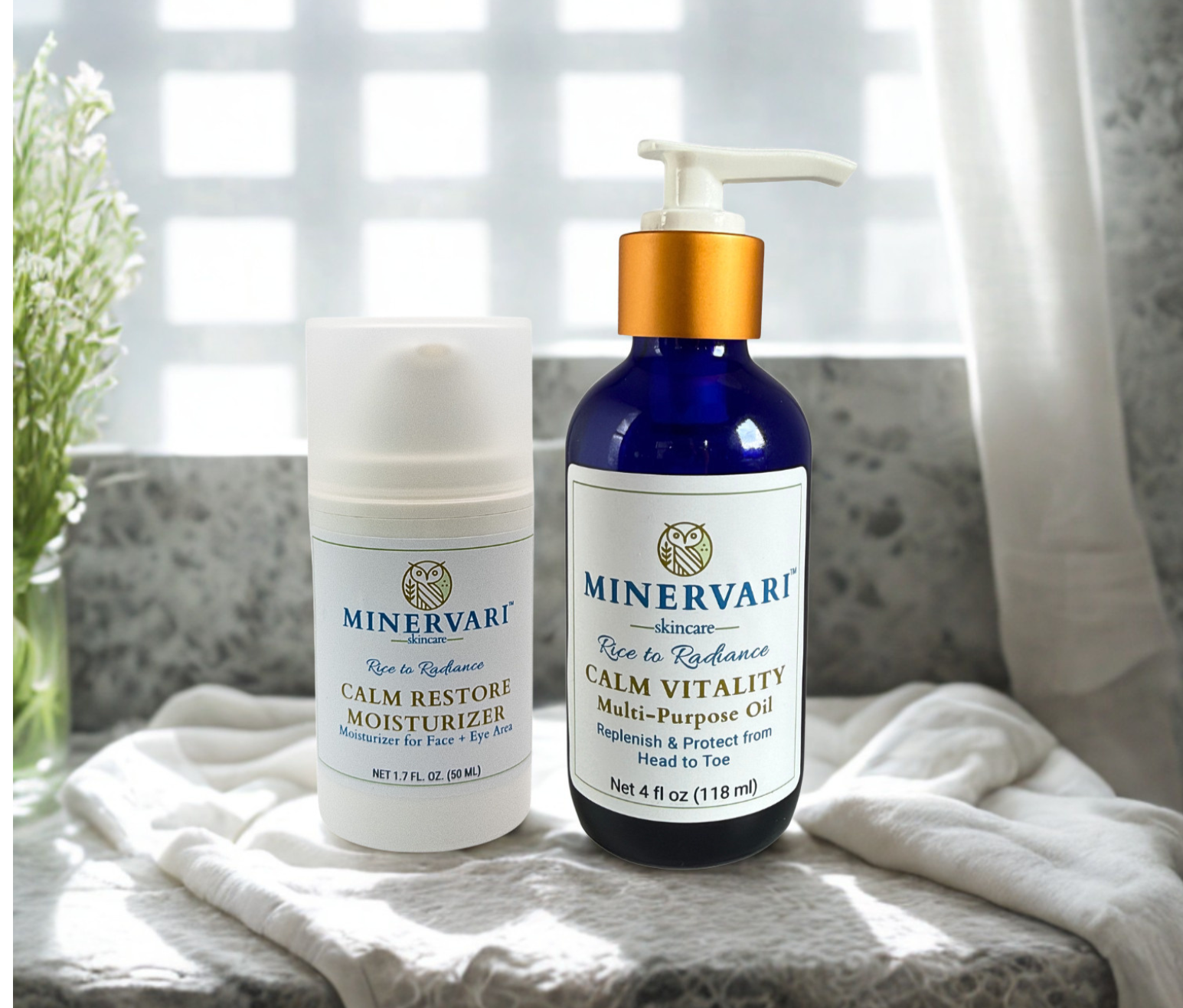
Rice bran oil has a place in two different MINERVARI formulas—and it serves within two different product experiences.
Calm Restore Moisturizer
In Calm Restore Moisturizer, rice bran oil is part of an emulsion that also includes rice bran water, squalane, glycerin, niacinamide, cupuaçu butter, panthenol, Ceramide NP, a hyaluronic-acid complex, and other supporting ingredients.
Here, rice bran oil is one part of a broader approach to lightweight hydration, emollience, and barrier-supportive care for the face and eye area.
Calm Vitality Multi-Purpose Oil
In Calm Vitality Multi-Purpose Oil, rice bran oil becomes part of an entirely oil-based blend alongside avocado, kukui, grapeseed, borage, raspberry seed, squalane, vitamin E, and other oils.
The experience is different because the formula is different.
One ingredient can make sense in more than one type of product without playing exactly the same role in each.
Thoughtfully Made Means Looking Beyond the Hero Ingredient
Skincare marketing often encourages us to look for one ingredient that explains everything about a product.
Formulation rarely works that way.
Rice bran oil is meaningful to MINERVARI because it connects our formulas to rice, because it works well as an emollient, and because its chemistry is genuinely interesting.
But it still has to earn its place alongside the rest of the formula.
That is the philosophy behind Thoughtfully Made.
We want to look beyond ingredient trends and ask different questions:
Why is this ingredient here?
What does it contribute?
What works alongside it?
And does the finished formula make sense for the skin it was designed to support?
For rice bran oil, the answers bring together agriculture, cosmetic science, and formulation in a way that feels very much at home in MINERVARI.
Rooted in Nature. Inspired by Rice.
Thoughtfully made. Purposefully simple.